Cinelytix
A data-driven platform for film enthusiasts to track, analyse, and share their viewing habits with like-minded communities.
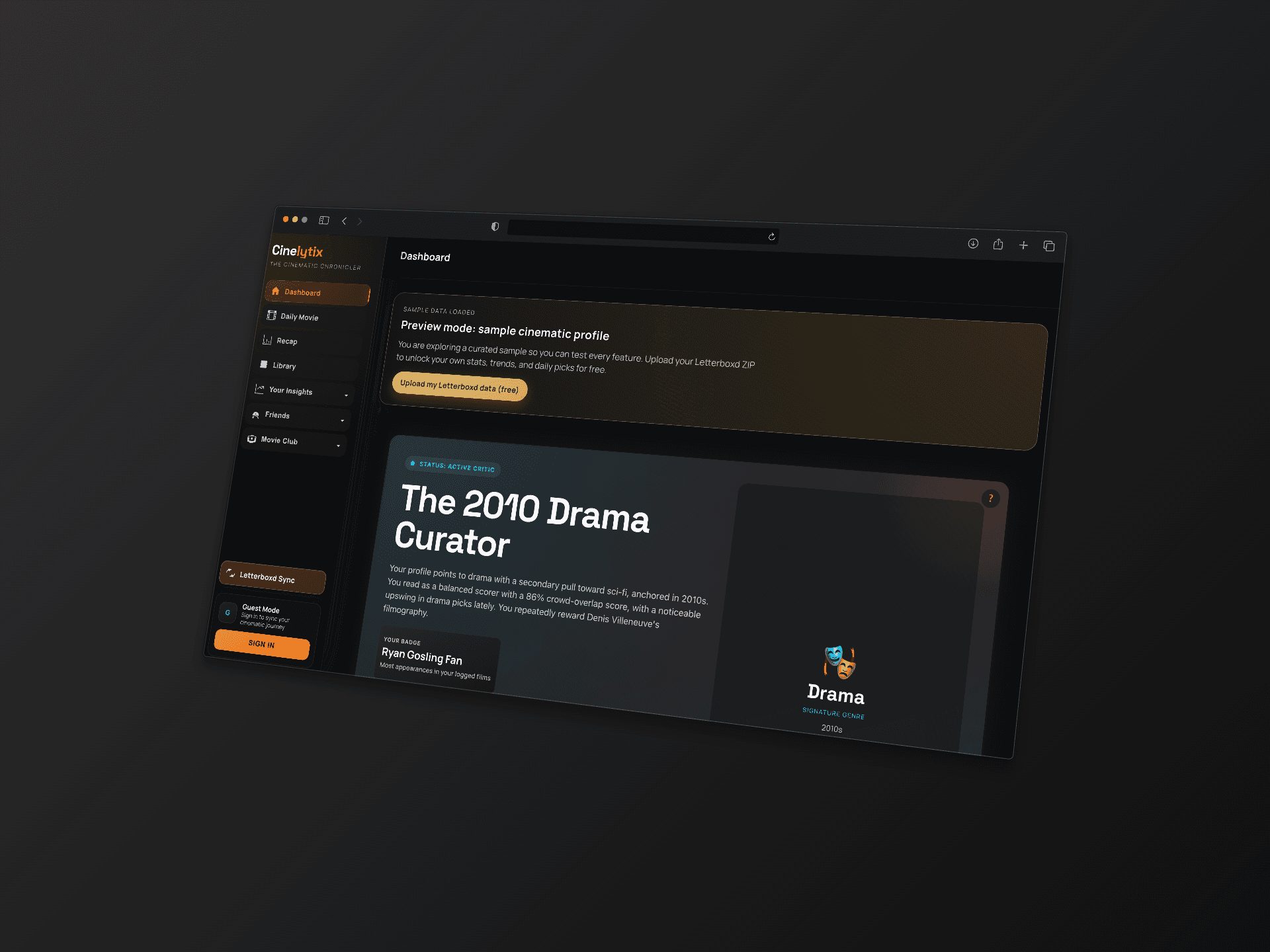
The Vision
Film enthusiasts generate data constantly, what they watch, when they watch it, how they rate it, what they're planning to see next. But that data sits scattered across streaming platforms, never surfaced in a way that's actually useful or shareable.
Cinelytix was built to change that: a platform where users own their viewing data, discover patterns in their taste, and connect with communities who share their obsessions.
What We Built
A full-featured analytics and social platform for film, designed to handle high-volume external API integration without compromising user experience.
Personal Viewing Analytics
Users can log films and see their data come to life:
- Viewing history with rich metadata pulled from TMDB
- Taste profiles built from ratings, genres, directors, and eras
- Year-in-review breakdowns and trend visualisations
- Watchlist management with recommendations based on viewing patterns
Community Features
Film is better shared. Cinelytix lets users:
- Create and join groups around genres, directors, or themes
- Share lists, reviews, and ratings with their community
- Participate in group challenges and watch-alongs
- Discover what's trending within their circles
Seamless Data Enrichment
Every film logged is enriched with metadata from The Movie Database (TMDB), cast, crew, posters, synopses, and more, without users lifting a finger.
Technical Architecture
The real challenge wasn't the features, it was building a system that could hit external APIs at scale without falling over or getting rate-limited into oblivion.
Queue-Based Processing
Rather than making synchronous API calls on every user action, we implemented a job queue architecture. Film lookups, metadata refreshes, and batch operations are processed asynchronously, keeping the UI snappy regardless of backend load.
Redis Rate Limiting
TMDB enforces strict rate limits. We use Redis to track API consumption in real-time, throttling requests intelligently to stay within limits while prioritising user-facing operations over background tasks.
Caching Layer
Frequently accessed data, popular films, trending content, user feeds, is cached aggressively to minimise redundant API calls and database queries.
Technical Stack
- Frontend & Backend: Next.js for a unified, server-rendered experience
- Database: PostgreSQL for relational data, Redis for caching and rate limiting
- Queue System: Background job processing for async API operations
- External APIs: TMDB for film metadata and imagery
The Outcome
Cinelytix demonstrates that consumer platforms can be built with the same architectural rigour as enterprise software. The queue-based approach and rate limiting infrastructure means the platform can scale to high user volumes without degradation, or unexpected API bills.